May 7, 2026
What gives Mission Hills its unmistakable feel? It is not just the homes themselves. It is the way architecture, landscape, and long-range planning come together to create a place that still feels intentional more than a century later. If you are curious about why Mission Hills stands out in Johnson County, this guide will help you understand its historic charm, signature home styles, and the design choices that continue to shape its appeal today. Let’s dive in.
Mission Hills was envisioned in 1912 by J.C. Nichols as a planned garden community, not a typical suburban neighborhood. That origin still matters because the city’s character was built around wooded hills, winding streams, naturalistic landscaping, and open green space.
The setting is a major part of the story. Mission Hills describes three golf courses forming a green belt around the homes, which helps explain why the area feels so open, green, and carefully framed. Instead of feeling built out all at once, it feels shaped by the land.
That original plan continued to influence the city as it grew. Mission Hills incorporated in 1949, and by 1960 most of its physical expansion was already complete with about 1,330 homes and just over 3,500 residents. Today, that relatively limited housing stock adds to the sense of consistency and long-term identity.
One of the most interesting things about Mission Hills is that its current appearance is still closely tied to its early land plan. This is not a neighborhood that had to recreate charm later. Much of its appeal comes from original decisions about lot layout, street design, walkways, and preserved natural features.
The city’s planning documents place real emphasis on open space, monuments, and a pastoral garden character. That means the beauty you notice here is not accidental. It has been part of the community’s vision from the beginning.
You can also see that in the road network and walking routes. Mission Hills notes that J.C. Nichols favored walkways through green space rather than conventional sidewalks, allowing trees and grass to remain visually dominant. Combined with rolling topography and scenic views, those choices help create the calm, established feel many buyers notice right away.
Architecture is a big reason Mission Hills has such a strong identity. According to the city profile, most buildings were built between 1901 and 1944, and 85% of homes were built before 1970. That older housing stock gives the area a sense of depth and craftsmanship that is hard to replicate.
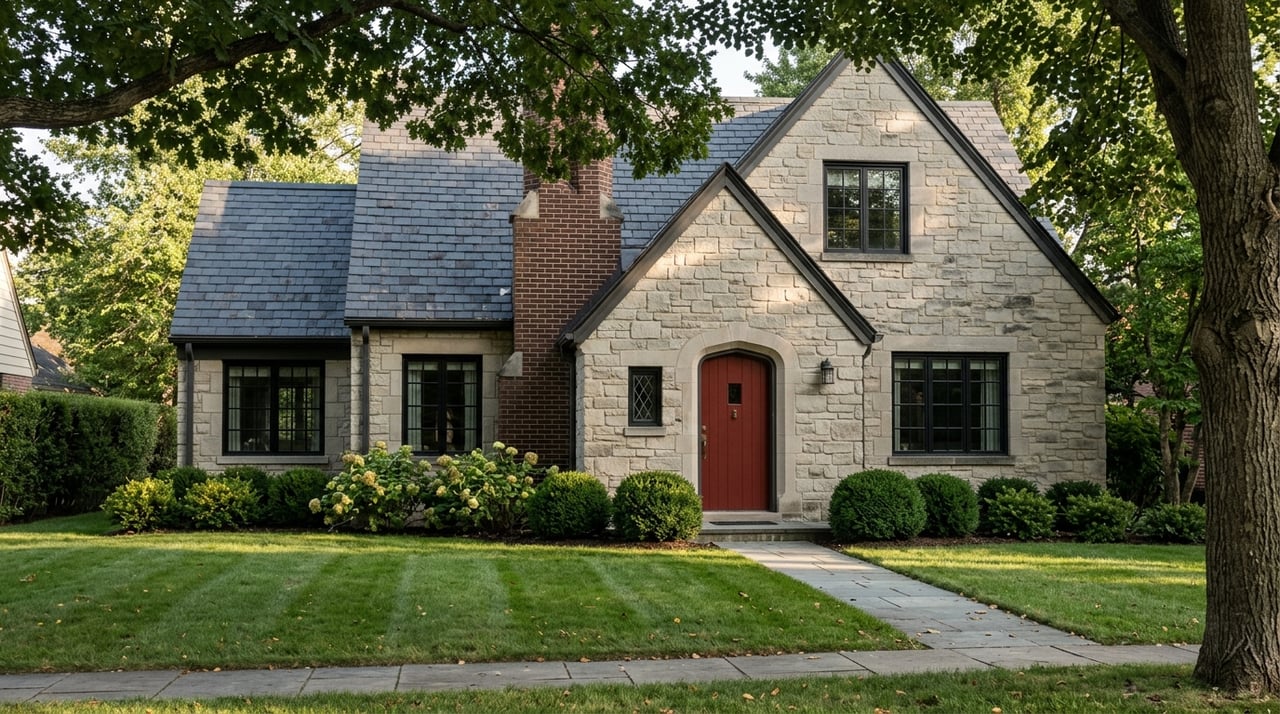
The two styles most closely associated with Mission Hills are Colonial Revival and Tudor. These homes often contribute to the neighborhood’s classic look, with period details, established lot placement, and a relationship to the surrounding landscape that feels thoughtful rather than formulaic.
At the same time, Mission Hills is not visually one-note. The city includes a range of homes, from refined period residences to larger estate properties with notable site design. That variety is part of the appeal because it keeps the area interesting while still feeling cohesive.
Two National Register properties help illustrate the architectural range found in Mission Hills. The Horn-Vincent-Russell Estate is recognized as a high-style Tudor Revival residence with important landscape-architecture value.
The Wolcott House offers a different expression, blending French Eclectic and Tudor Revival elements. It sits on a 2.1-acre hilltop lot overlooking the country clubs, showing how architecture and site placement work together in Mission Hills.
These examples matter because they show that the neighborhood’s historic charm is about more than age alone. It is also about design quality, materials, scale, and how homes relate to their setting.
In Mission Hills, the landscape does as much work as the architecture. Mature trees, rolling terrain, green corridors, and open views all shape how the city feels from the street.
The country-club backdrop is especially important. Mission Hills Country Club was founded in 1914, and Kansas City Country Club relocated to Mission Hills in 1926. Along with Indian Hills, these clubs form the greenbelt buffer referenced in city planning materials.
That greenbelt helps explain why so many streets feel shaded, spacious, and visually soft. Instead of block after block of tightly framed development, you get an environment where lawns, trees, fairways, and architecture interact in a more layered way.
Mission Hills also maintains a strong focus on its tree canopy. The city has a preferred tree list and a pruning program for city trees, which supports the mature, shaded appearance people often associate with the area.
The city’s visual identity is not limited to homes and greenery. Mission Hills says that many parks and parklets contain fountains, statuary, urns, and sculpture, much of it originally acquired by J.C. Nichols beginning in 1923 and now maintained by the city.
That detail helps explain why the neighborhood can feel curated without feeling overdone. Public art, monuments, and landscaped features are woven into the environment in a way that reinforces the area’s historic garden-community roots.
Historic charm tends to hold up best when a community actively protects it. In Mission Hills, that preservation is built into the local process.
The Architectural Review Board reviews exterior work before permits are issued, and the city’s design guidelines were adopted to preserve the community’s design heritage and support strong property values. For homeowners, that means visible changes are considered within the broader context of the neighborhood.
This matters if you are buying in Mission Hills because the area’s character is not left entirely to chance. The built environment, streetscape, and exterior appearance are part of what the city is intentionally trying to preserve.
For sellers, that can also be an important part of the value story. Buyers are often drawn to places where the look and feel of the neighborhood has been maintained over time.
Mission Hills remains one of the higher-value housing markets in the Kansas City area. Johnson County reported a 2026 average appraised value of $1,809,149 for Mission Hills, while Zillow reported an average home value of $1,603,473 as of March 31, 2026.
Those figures are useful as directional indicators, but they are not interchangeable. They measure different things, so the better takeaway is not a single number. It is the broader pattern of sustained value.
Part of that value story comes from the combination of limited housing supply, historic architecture, preserved landscape features, and design standards that help maintain the neighborhood’s character. With only about 1,330 homes, even a small number of large sales can affect annual averages, which is another reason broad trends matter more than one headline figure.
If you are considering a home in Mission Hills, it helps to look beyond square footage and finishes. The setting and long-term design framework are a major part of what you are buying.
As you tour homes, pay attention to:
These factors can influence both day-to-day enjoyment and long-term resale appeal. In a place like Mission Hills, context matters almost as much as the house itself.
If you are preparing to sell a Mission Hills home, the neighborhood story deserves a clear place in your marketing. Buyers are often responding to more than finishes and room counts.
Strong listing presentation can help frame features like architectural style, lot placement, mature trees, greenbelt surroundings, and preserved neighborhood character. In a market where design heritage matters, thoughtful marketing can help buyers understand what makes a property distinctive.
That is especially true in an area where homes may differ in age, style, and site design. A polished strategy can help connect your property to the larger Mission Hills story in a way that feels clear and compelling.
Mission Hills has earned its reputation through careful planning, historic architecture, and a landscape that still feels intentional generations later. If you are buying, selling, relocating, or simply trying to understand what makes this part of Johnson County so special, working with a local team that knows how to position that value can make all the difference. When you are ready to talk strategy, connect with Hannah Murrell for a concierge-level experience tailored to your next move.
Explore additional articles offering fresh perspectives on Kansas City real estate and lifestyle.
Partner with Murrell Signature Real Estate Group and enjoy a real estate experience that’s personal, polished, and powerful.
MURRELL SIGNATURE REAL ESTATE GROUP
ADDRESS 4200 SOMERSET DR PRAIRIE VILLAGE KS 66208