
August 20, 2026
All through July, Friday evenings at Pioneer Park followed the same pattern. Blankets down on the lawn along Washington Place before the sun cleared the treeline, a folding chair or two by six o'clock, then a band running a soundcheck while neighbors caught up between coolers. The run closed out on July 31 with That Beatles Cover Band. It looked, from the lawn, like the kind of thing a city puts on. It wasn't.
The Mission Hills Concerts in the Park series is run by the Mission Hills Town Council, an all-volunteer resident organization, and it was funded almost entirely by the people sitting on those blankets. Production costs run over $7,000 per show. Earlier this summer, the season's fundraising page showed donations from residents and local businesses covering most, but not all, of a $50,000 goal, with the tally sitting at $44,372. That gap is the actual story of how a Friday night at Pioneer Park comes together: not a line item in a city budget, but a shortfall neighbors had to close themselves, show by show.
The Friday lineup this year opened July 4 with the traditional midday BBQ and parade, then ran straight through Friday-evening shows on July 10, 17, 24, and 31, all six to eight at Pioneer Park. The season closed in mid-August with one last concert moved to a different venue, a shift from the Town Council's usual practice of keeping the whole run at Pioneer Park.
None of it is new to Mission Hills. The Town Council has run Friday concerts at Pioneer Park for years, drawing crowds that have historically numbered in the hundreds, picnic baskets included. What's worth noticing is how little of that tradition touches the city's own budget. The same Town Council is separately raising money to resurface the tennis courts at Pioneer Park, another amenity that exists because residents wrote checks for it, not because it showed up in a capital improvement plan.
That matters if you've ever wondered why the concert schedule sometimes shifts venues or trims a date. It's not city planning. It's whatever the donation total allows.
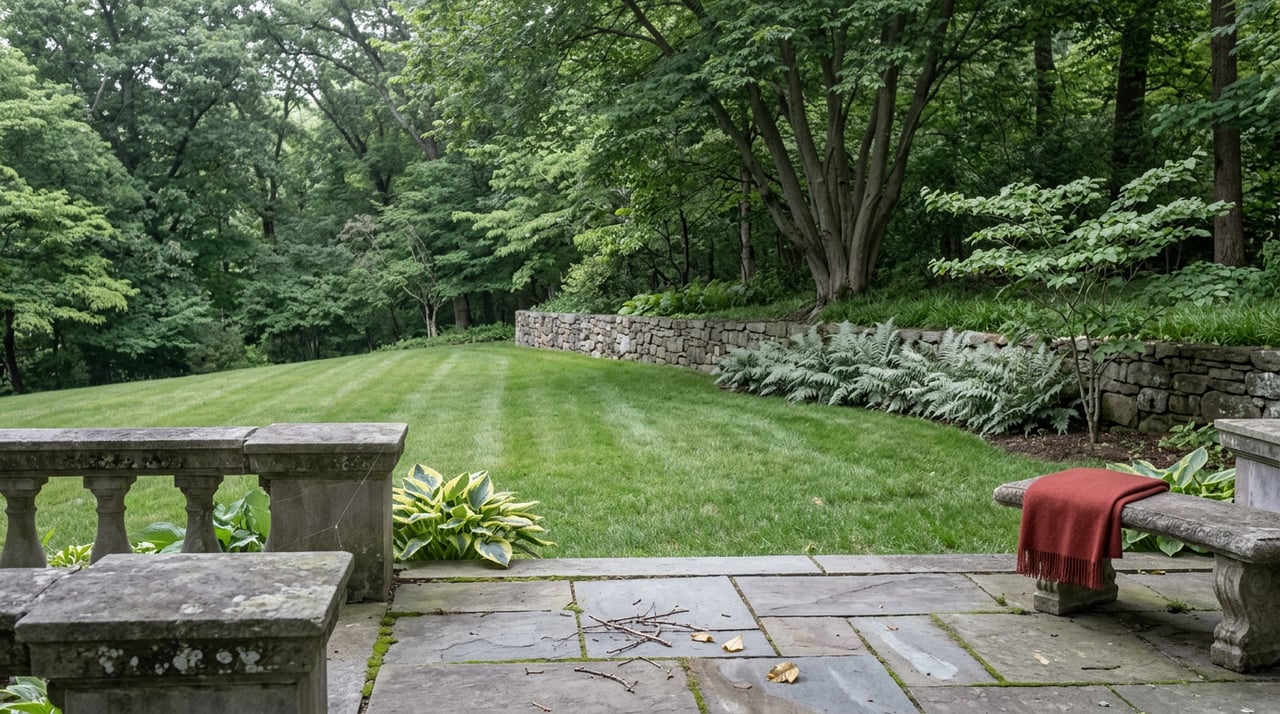
A few blocks away, just north of 63rd Street, the Sunken Garden tells a similar story from an earlier chapter. The garden was one of J.C. Nichols' original design features for Mission Hills, built with a reflection pool and plantings meant to anchor the neighborhood's identity as a garden suburb. It fell into disrepair for years, hit by the kind of drainage and irrigation problems that come with age and Kansas City's weather swings, before a run of community donations and contractor work brought back the irrigation system, the lawn, and the working fountains.
That restoration is why the garden could host something like this year's June 12 concert, when musician Sean McNown played from 5:30 to 8 p.m. with the Crave KC Tacos food truck parked on site. A garden that was quietly falling apart a few years ago is now a place people schedule an evening around. That's not atmosphere. That's the return on money residents already put in.
Set that against what's happening on Indian Lane. The low-water crossing at Mission Drive and Indian Lane, right at the entrance to the Kansas City Country Club, closed for repairs to the stacked stone wing walls that flank it. Those walls have been washing out, a maintenance issue the city says isn't showing up at other similar crossings around town. While the repair is underway, the only way into KCCC's main entrance is by heading north on Indian Lane from 63rd Street. As of the city's most recent project update in late July, that work was still in progress.
It doesn't end there. Once the crossing repair wraps and reopens, Indian Lane north of 63rd Street closes again, this time to replace a failing stormwater culvert running beneath the road. Two separate closures, back to back, on the same short stretch of street.
A few blocks over, Belinder Road is in its own long stretch of work. Street, stormwater, and utility improvements started in June 2026 across Belinder Avenue, part of 69th Street, and 70th Terrace, with WaterOne, Kansas Gas, and Google Fiber all sequencing their own projects through the same corridor. Kansas Gas has been replacing lines between 67th and 69th, work the city expects to wrap by Thanksgiving, with WaterOne and fiber work layered in around it.
None of this runs on donations. It's capital improvement money, moving at the pace capital improvement projects move at, which is to say slower and with more detours than anyone standing on a Pioneer Park blanket has to deal with.
Put the two threads next to each other and the shape of Mission Hills right now gets clearer. The parts of daily life that feel most like community, the Friday concerts, the garden, the tennis courts, existed this summer because residents funded them directly and repeatedly, sometimes short of goal, sometimes shifting a venue to make the math work. That season has a start and an end date. It closed in mid-August. The parts that require actual engineering, the crossings and culverts and utility corridors, run on the city's own capital process, and that process doesn't pause when the concert season does. The Indian Lane closures and the Belinder corridor work are still going as of this writing, with no concert-style finish line in sight.
Mission Hills has always described itself as a low-key place, one that skips the big festivals in favor of small traditions like the annual Street Fair and the Verona Columns Concert. That's still true. What's easy to miss, if you only caught the concert flyer back in July or only read the road closure notice this week, is that both were running on completely different fuel the whole time. One was neighbors closing a gap in a fundraising page, a job that wrapped for the year. The other is a capital improvement schedule working through a list that still includes a stormwater culvert most residents won't think about until their street is the one that's blocked.
The concerts are done until next summer. The roadwork isn't. If you're mapping out how to get to the Kansas City Country Club entrance or timing a drive down Belinder this month, you're dealing with the half of Mission Hills that doesn't run on a donation page or a season schedule.
If you ever want to talk through what any of this means for your own property, from the Indian Lane detour to how a restored Sunken Garden and an active concert series shape the way a home here shows, Hannah Murrell knows this neighborhood block by block. Schedule Your Strategy and start your Red Bow experience whenever you're ready.
Explore additional articles offering fresh perspectives on Kansas City real estate and lifestyle.
Partner with Murrell Signature Real Estate Group and enjoy a real estate experience that’s personal, polished, and powerful.
MURRELL SIGNATURE REAL ESTATE GROUP
ADDRESS 4200 SOMERSET DR PRAIRIE VILLAGE KS 66208